| Key Features |
Key Benefits |
| Configurable digital inputs (12). |
Provides multiple installation options. |
| Configurable analogue / digital inputs (4). |
Provides multiple installation options. |
| Configurable flexible sender inputs (2). |
Provides multiple installation options. |
| Configurable DC outputs (8). |
Provides multiple installation options. |
| Configurable volt-free outputs (2). |
Provides multiple installation options. |
| Configurable 5 stage dummy load and load shedding outputs. |
Allows load options and dummy load requirements to be independently controlled. |
| Tier 4F Stage V CAN engine support. |
Compatible with the latest engine technology. |
| Independent ports for RS485, CAN, USB and Ethernet. |
Provides flexible connection options. |
| MODBUS RTU / TCP IP support. |
Provides simple flexible communication options. |
| In-built SNMP. |
Enables simple transfer of data between devices on same network. |
| 3-phase mains (utility) & generator voltage and current sensing. |
Monitors mains (utility) and generator. |
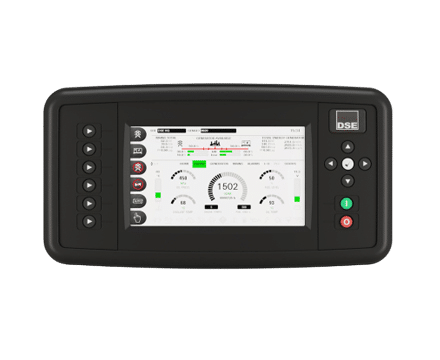
| 7″ full colour TFT display. |
Presents system information clearly. |
| Optically bonded sunlight readable display. |
Enhances readability in high humidity environments. |
| Hi-clarity 800 x 480 pixel graphical user interface. |
Displays graphics in crystal clear resolution. |
| Built-in AVR governor and CAN control. |
Ideal for multiple application environments. |
| Two types of KW/VAr sharing support (isochronous or droop). |
Offers flexible support options for ultimate flexibility. |
| Drag and drop advanced PLC editor. |
Ensures additional applications are easily integrated into the system. |
| IEEE 1547TM – 2018 compliant. |
Ensures the module is compliant to the latest standards. |
| Configurable for use as a DSE8910 load sharing control module. |
Provides flexibility for multiple application use. |
| 2 starting sequences: start all / starts load requires. |
Provides advanced flexibility. |
| Peak lopping / load sharing. |
Enables an additional power source to be used when grid has no remaining power. |
| Manual voltage / frequency adjustment. |
Provides flexibility to the user. |
| RoCoF and vector shift protection. |
Provides protection monitoring. |
| Generator load demand. |
Ensures load on generators is maintained at optimum operating levels. |
| Automatic hours run balancing. |
Maintains even wear on generators. |
| Mains (utility) decoupling. |
Detects mains (utility) failure. |
| Bus failure detection. |
Detects failures on the bus. |
| Volts and frequency matching. |
Provides automatic detection. |
| Dead bus synchronising. |
Provides rapid power delivery on multi-set systems. |
| DSENet® expansion. |
Provides simple expansion device connection. |
| DSEWebNet® compatibility. |
Provides remote monitoring capability. |